Shipping a full-stack product is less like crossing a finish line and more like opening a door for real people. The moment someone else uses the product, every shortcut becomes a behavior they have to live with, and every unclear decision becomes a question they have to answer alone.
I learned this by building features that looked complete in my browser but became more complicated when connected to real data, real delays, and real mistakes. A polished button is only one small part of the work. The product also needs a trustworthy request, a useful response, a safe failure state, and a way to understand what happened afterward.
Start with the smallest useful path
Shipping is a series of decisions about what not to build. Before adding settings, dashboards, or edge cases, define the smallest path that creates value. What does a person enter? What does the system do? What should they see when it succeeds?
Write that path down before writing the feature. A small product surface gives every important path more attention, and it makes feedback easier to interpret. If the first version tries to solve every possible future problem, it becomes difficult to tell which part is actually helping.
const result = await createProject(input)

return {
  id: result.id,
  status: "created",
  next: "/projects/" + result.id
}
Even a small response contract helps the frontend and backend agree. Keep names predictable, return only what the client needs, and make the next action obvious.
Keep the boundaries clear
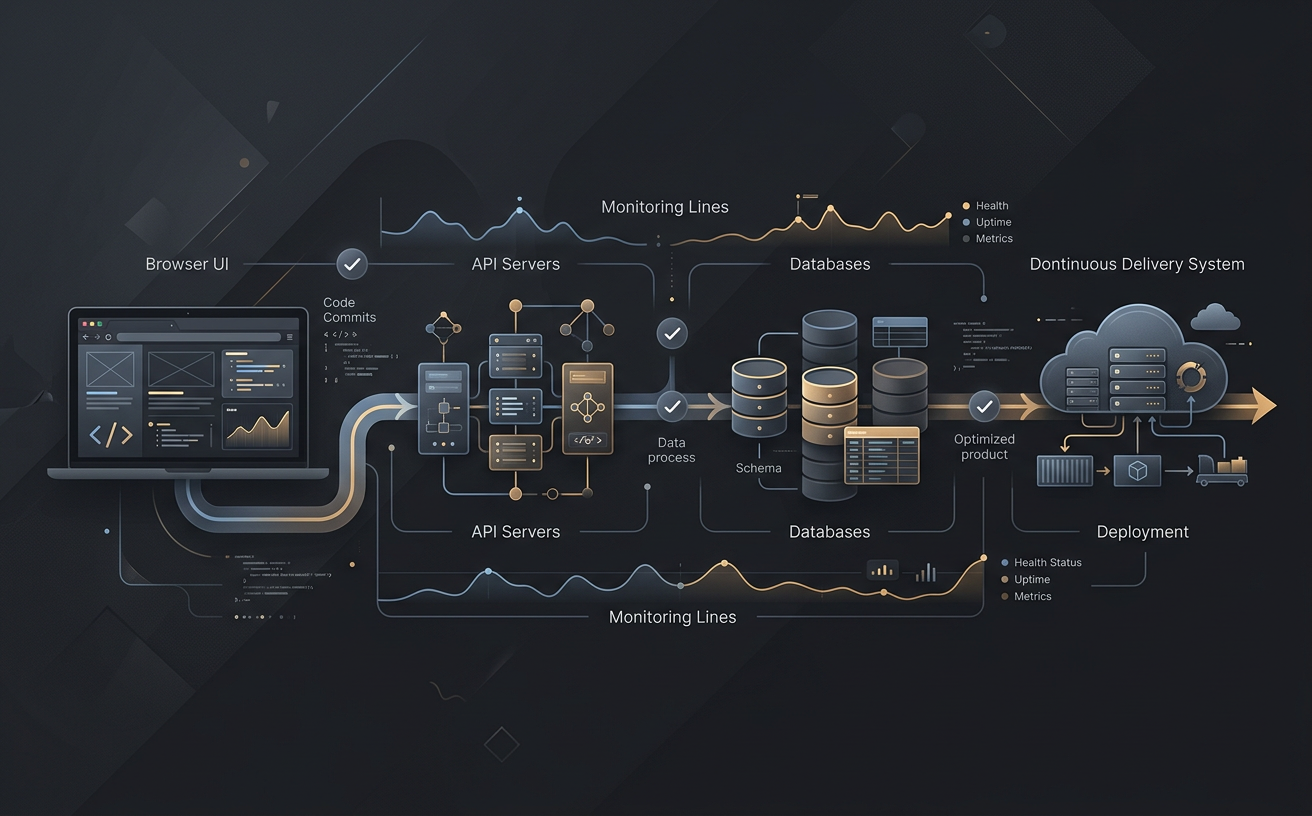
I keep the boundaries clear: accessible UI, predictable data flows, and backend behavior that is easy to observe. The browser should handle interaction and presentation. The server should validate input, enforce permissions, and perform trusted work. The database should preserve the source of truth instead of becoming a hidden collection of accidental state.
Never trust values only because they came from your own interface. Validate again on the server. Check required fields, normalize text, confirm ownership, and return useful errors without leaking internal details.
const parsed = schema.safeParse(body)

if (!parsed.success) {
  return Response.json(
    { error: "Please check the required fields." },
    { status: 400 }
  )
}
Design for the waiting and the failure
A network request is not instant, and pretending otherwise makes a product feel broken. Show that work has started. Prevent accidental duplicate submissions. Preserve the user's input when a request fails, and explain what they can do next.
Reliable products are not perfect. They are understandable when something goes wrong and simple to improve when the next lesson arrives. A timeout should not erase a form. A missing record should not become a blank page. An error message should answer three questions: what happened, whether anything changed, and what action is safe now.
Make data flows observable
When a user says “it did not work,” you need more than a screenshot. Give important operations a request identifier, log useful timing information, and track failures at the boundary where they happen. Avoid logging passwords, tokens, or private user content. Observability should help you debug without creating a second security problem.
For a small product, a practical checklist is enough: record server errors, measure slow requests, monitor failed writes, and test the unhappy paths intentionally. The goal is not to build a giant operations center. The goal is to shorten the distance between a problem and an understandable fix.
Ship in slices, not guesses
I have found that the safest release is usually a narrow one. Put one complete workflow in front of a few people, watch where they hesitate, and improve the actual path before expanding the feature set. Documentation becomes better too, because it is written from behavior that exists rather than promises about behavior that might exist.
Before release, test the experience as a new user, a returning user, and a user who makes a mistake. Check keyboard access, mobile layout, empty data, slow connections, expired sessions, and repeated clicks. These are not polish tasks; they are part of the product contract.
A practical shipping checklist
For every full-stack feature, ask:
- What is the smallest successful user journey?
- Where is input validated and where are permissions enforced?
- What happens during loading, timeout, failure, and retry?
- Can I observe the operation without exposing sensitive data?
- Does the documentation explain the real behavior and its limitations?
- Can a person recover without losing their work?
Shipping is not about proving that nothing will ever go wrong. It is about making the important path clear, the dangerous path guarded, and the broken path recoverable. Once those foundations are in place, the rest of the system becomes much easier to reason about—and much more worthy of someone's trust.